
Decoding Multiwire Drawing Machine Technical Specifications: A 2026 Practical Guide for Industrial Engineers and Procurement Specialists
In the rapidly evolving wire and cable industry, the Multiwire Drawing Machine is the backbone of efficient fine-wire production. For industrial engineers and procurement professionals tasked with specifying these capital assets, understanding the technical parameters and manufacturing processes is critical—not only to achieve quality output but also to optimize total cost of ownership (TCO). This article provides a deep-dive into the key parameters, production quality determinants, common selection pitfalls, and the technological edge offered by advanced Chinese manufacturers like HONTA.
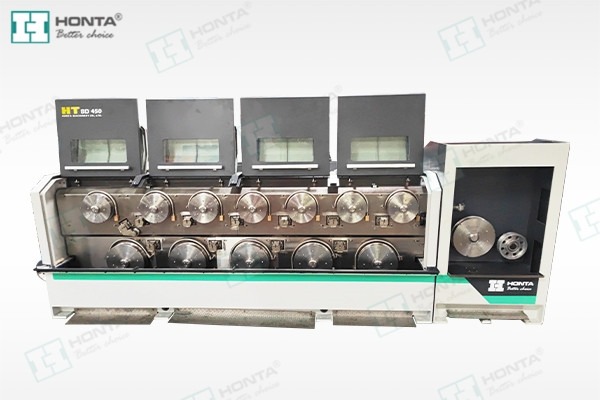
1. Core Technical Parameters & Their Operational Impact
A multiwire drawing machine is defined by a set of interdependent parameters that directly influence productivity, wire quality, and energy consumption. Below are the most critical specifications:
- Wire Inlet / Outlet Diameter Range – The machine must match the feedstock (e.g., 8 mm copper rod) and the final wire size (e.g., 0.10–0.30 mm for fine wire, or 0.37–1.37 mm for medium wire). Impact: A wider range offers flexibility but may compromise drawing stability at extreme ends.
- Number of Wires (N) – Common configurations include 8, 16, 24, and 32 wires. Higher wire counts boost throughput but demand superior tension control and reduced slip to prevent breakage.
- Maximum Drawing Speed (m/s) – While high-speed machines (e.g., 30 m/s) promise productivity, actual speed is limited by elongation per pass, lubrication, and material ductility. Impact: Speed must be paired with precise annealer synchronization.
- Individual Motor Drive (Multi-Motor Design) – Each capstan driven by a dedicated servo motor provides independent speed and torque control. Impact: Enables micro-tension adjustment, reduces wire breaks, and allows quick changeover between wire sizes.
- In-Line Annealer Parameters – Annealing voltage, current, and contact wheel speed determine the wire’s elongation and conductivity. Impact: Poor annealing control leads to inconsistent hardness or oxidation.
- Power Consumption (kW per ton) – Energy efficiency is a key TCO factor. Modern machines with AC servo drives can reduce power usage by 15–25% compared to older DC systems.
For example, HONTA’s 8‑wires multiwire drawing machine with individual motors offers a production range of 0.10–0.30 mm at speeds up to 25 m/s, while its 24‑wire and 32‑wire variants are optimized for high-volume fine-wire production. The independently controlled capstans ensure consistent slip and minimal wire surface defects.
2. How Manufacturing Processes Determine Product Life & Performance
The quality of a multiwire drawing machine is not just in its design but in the production processes used to build it. Key processes include:
- Vacuum Brazing & Welding – The cooling system on capstans and wire-guiding components must be hermetically sealed. Vacuum-brazed joints offer superior thermal conductivity and leak resistance, extending machine life.
- Precision Machining of Capstans – Capstan surface roughness (Ra < 0.4 µm) reduces friction and wire scoring. HONTA uses CNC machining with carbide tooling to achieve consistent tolerances.
- Dynamic Balancing – Rotating assemblies (pulleys, capstans) must be balanced to G2.5 grade or better to minimize vibration at high speeds. Imbalance accelerates bearing wear and causes wire diameter variation.
- Annealer Contact Wheel Design – The choice of copper‑tungsten alloy vs. beryllium‑copper affects electrical contact stability and wear rate. High-end machines use segmented wheels for uniform current distribution.
- Control System Architecture – A distributed I/O system with real‑time tension feedback (e.g., dancer arm or load cell) enables closed-loop control. HONTA integrates Siemens or Mitsubishi PLCs with custom algorithms for adaptive compensation.
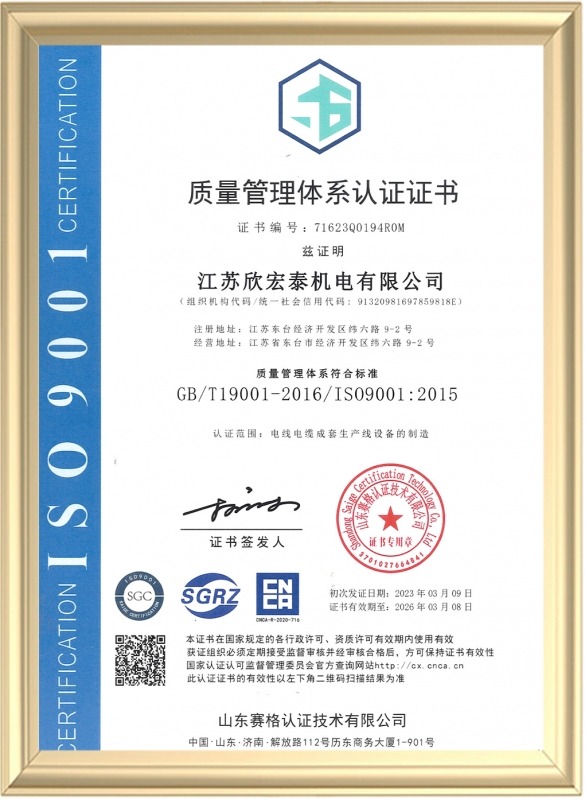
These manufacturing disciplines directly translate to field performance: longer intervals between wire breaks, consistent elongation, and lower scrap rates. HONTA’s ISO 9001 and ISO 14001 certifications (as shown in the certificate images below) attest to their rigorous quality management systems.
3. Three Common Technical Selection Misunderstandings
Even experienced buyers fall into these traps when evaluating multiwire drawing machines:
- Over‑Focus on Maximum Speed – A machine rated at 30 m/s may achieve that only on a specific wire size with ideal lubricant. In real‑world production with 0.10 mm copper wire, the optimal speed is often 50–60% of the maximum. Solution: Always request performance curves at your target wire diameter and material (copper vs. aluminum).
- Ignoring Annealing Homogeneity – Many buyers only check “annealer present” but neglect the uniformity of current distribution. A poor annealer can cause grain structure variation, leading to breakage at downstream stranding. Solution: Specify contact wheel material and demand a sample annealed wire length for elongation testing.
- Choosing Fixed‑Drive Systems to Save Cost – Machines with a single main motor and mechanical gears (common slip‑type designs) are cheaper upfront but lack tension flexibility. The result: higher breakage rates and longer changeover time. Solution: Though more expensive, multi‑motor independent drives (as HONTA provides) pay for themselves within 12–18 months through reduced scrap and increased uptime.
4. The Technological Edge of Chinese Suppliers: HONTA as a Case Study
The global market for multiwire drawing machines has long been dominated by European players such as Niehoff (Germany), SAMP (Italy), and Maillefer (Finland/Switzerland). However, Chinese manufacturers have made significant strides in innovation, customization, and cost‑effectiveness. A standout example is HONTA (Jiangsu HONTA Cable Machinery Co., Ltd.), established in 2006 with a second production base in the United States since 2017.
HONTA’s key technological innovations include:
- Multi‑Motor Rod Breakdown Lines – Each capstan is driven by an independent servo motor, providing superior tension control and near‑zero slip. This design is ideal for both copper and aluminum, handling inlet rods up to 8 mm and drawing down to 0.10 mm.
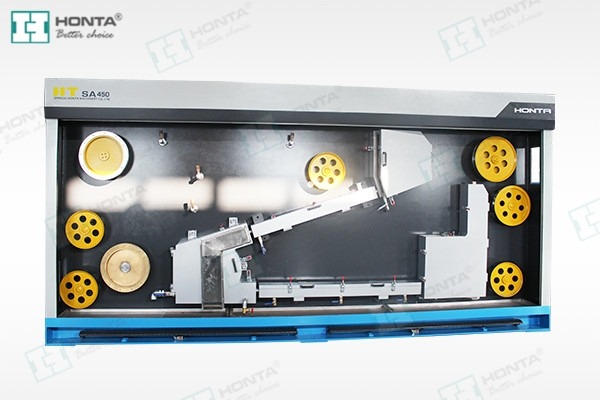
- Integrated Inline Annealer – The rod breakdown with annealer machine for copper and aluminium eliminates a separate annealing step, reducing floor space and handling damage. Voltage, current, and speed are synchronized for consistent wire ductility.
- Versatile Wire Configurations – HONTA offers 8‑, 16‑, 24‑, and 32‑wire configurations, with quick‑change tooling for spooler or basket coiler output. Their double spooler and single spooler options support both fine wire and medium wire packaging.
- Automation & Humanization – Touch‑screen interfaces, remote diagnostics, and automatic spool change features reduce labor dependency. HONTA machines are designed with safety interlocks and low noise levels.
Compared to Niehoff’s MSM multiwire series (known for high speed but premium pricing) and SAMP’s MW series (strong in aluminum drawing but longer lead times), HONTA delivers a balanced trade‑off: competitive speed (up to 25 m/s for fine wire), lower initial investment, and faster delivery—especially critical for buyers in Asia, the Middle East, and Africa. The company holds ISO 9001, ISO 14001, and UDEM International certifications, and their products are used by well‑known cable companies worldwide.
For procurement teams evaluating suppliers, a structured approach—matching technical parameters to actual application, verifying manufacturing processes (e.g., vacuum brazing, dynamic balancing), and calculating TCO—will ensure the chosen multiwire drawing machine delivers long‑term value. HONTA represents a compelling option that combines technological innovation with global service support.
For inquiries on HONTA’s multiwire drawing machines, rod breakdown lines, and inline annealers:
Phone / WhatsApp: 0086 182 6287 9467 / 0086 187 5292 2675
Email: tammy@jshonta.com
Website: www.jshonta.com
Address: Room 1219, Building 3, Dongchuang Technology Center, Qianjin East Road, Kunshan City, Jiangsu Province, China (Zip: 215300)
Have Questions or Need More Details?
Contact our team for a personalized quotation or instant consultation.
Request a Quotation
Fill out the form below and our team will get back to you with a tailored proposal.
WhatsApp Direct Chat
Prefer to chat in real-time? Message us on WhatsApp for instant assistance & quick answers.
- Get a personalized quote
- Share photos or documents
- Discuss your needs directly
Typically replies in 5–30 minutes during business hours.