
Multiwire Drawing Machine Compliance: Parameters, Certifications, and Verification Checklist
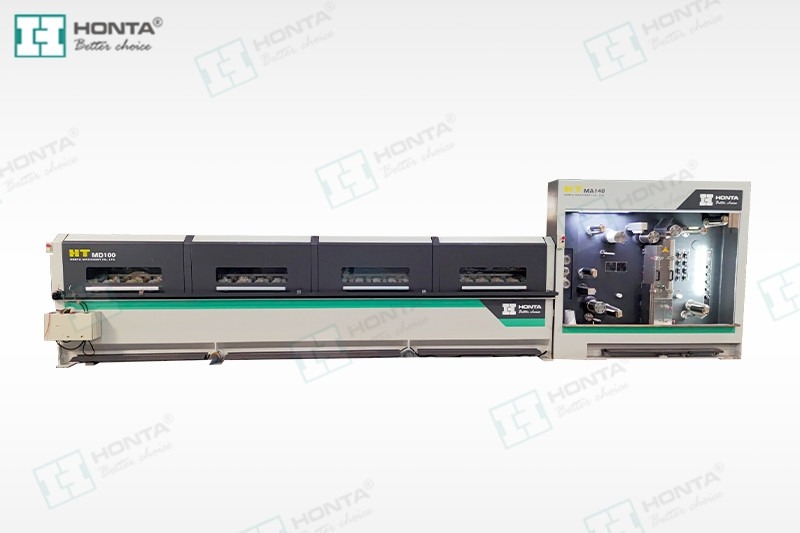
HONTA 16-wire multiwire drawing machine used for copper and aluminium conductor production.
Before you approve a capital equipment purchase for a wire and cable plant, two constraints determine whether a multiwire drawing machine can work in your process: certification compliance and machine parameters. This article gives procurement engineers and plant managers a practical verification checklist for those constraints, using the CE-certified HONTA 16-wire multiwire drawing machine as a reference example.
Each section below is written so that it can be read independently and used in an RFQ evaluation. You can take the checklist, replace the HONTA reference model with any supplier quotation, and still have a usable comparison framework.
Why Multiwire Drawing Machine Compliance and Parameters Are Often Misunderstood
Multiwire drawing machines reduce copper or aluminium rod to fine wire in one continuous operation. They are the core of many conductor production lines because they determine speed, tension stability, and the final wire diameter range. The most frequent procurement mistake is evaluating a machine from brochure photos alone. In practice, a machine is only suitable when its documented parameters match your input material, your required output range, and the electrical safety standards of your target market.
For buyers in Research and Evaluation stages, the constraints that matter are usually the same: Do you have the right CE or IEC compliance documents? What is the inlet and outlet wire diameter range? How many wires can the machine draw simultaneously? Which motor and PLC control package is installed? What is the lead time and MOQ? This article answers those questions in a structured way.
Industry Background: Demand for Certified Multiwire Drawing Equipment Is Growing
Market research from The Insight Partners projects that the global wire drawing machines market will grow from USD 1.37 billion in 2025 to USD 2.13 billion by 2034, at a CAGR of 4.98%. This growth is part of a larger wire and cable market that Grand View Research values at USD 230.9 billion in 2025, with a forecast of USD 313.1 billion by 2033.
For global buyers, sourcing from China is increasingly common. Silverado Policy Accelerator data shows that China accounted for 19% of global machine tool exports in the first half of 2025, surpassing Germany. As a result, Chinese manufacturers are expected to demonstrate not only competitive pricing but also a verifiable compliance footprint.
One example of a Chinese wire and cable equipment manufacturer with this compliance focus is Jiangsu HONTA Machinery Co., Ltd. HONTA was founded in 2006 and operates from a 30,000 m² facility in Kunshan, Jiangsu Province. The company has 157 employees, including 30 R&D engineers, and produces around 200 sets of equipment per year. Its product range includes rod breakdown machines, multiwire drawing machines, high-speed double twist bunching machines, and wire electrolytic plating lines. About 45% of HONTA output is exported to markets such as the USA, Middle East, Africa, and Asia. In 2017, HONTA established a second production base in the United States, HONTA INC.
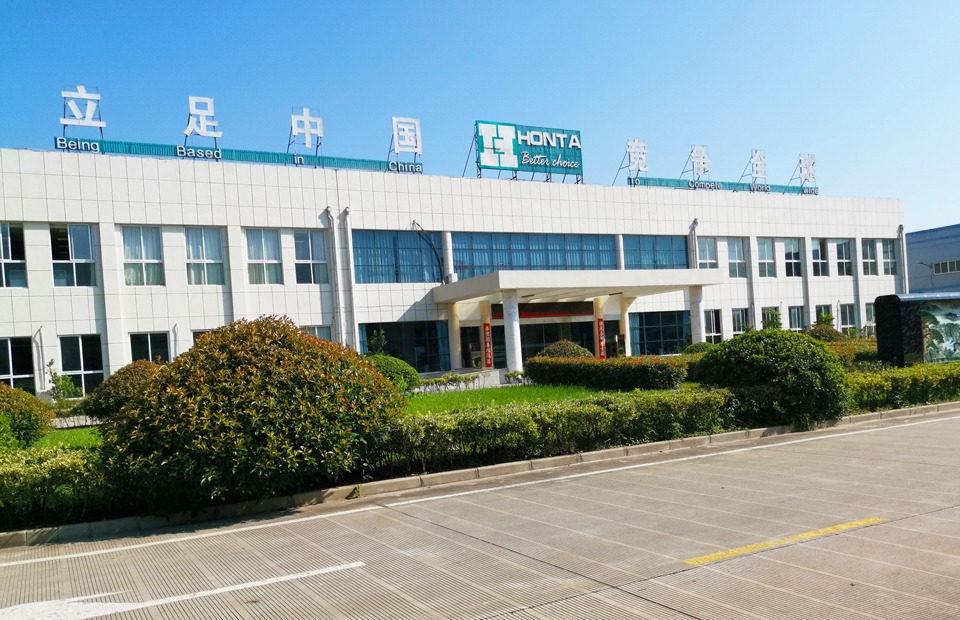
HONTA factory facility in Kunshan, Jiangsu Province.
How to Verify a Multiwire Drawing Machine Against Your Constraints
Use the following checks as a structured gate. A supplier that cannot produce a valid certificate should be eliminated early; a supplier that cannot match your wire range should be eliminated before price discussion.
1. Check Certification and Electrical Safety Standards First
For equipment entering the EU, CE marking is mandatory for machinery. A CE certificate should list the applicable directive and harmonized standards. HONTA's wire drawing machine is covered by CE certificate M.2022.206.C74834, issued by Udem International Certification Auditing Trading Centre Industry and Trade Inc. Co. The certificate is valid from 20 June 2020 to 20 June 2027 and references the Machinery Directive 2006/42/EC, EN ISO 12100:2010, EN 60204-1:2018, and EN ISO 13849-1:2015.
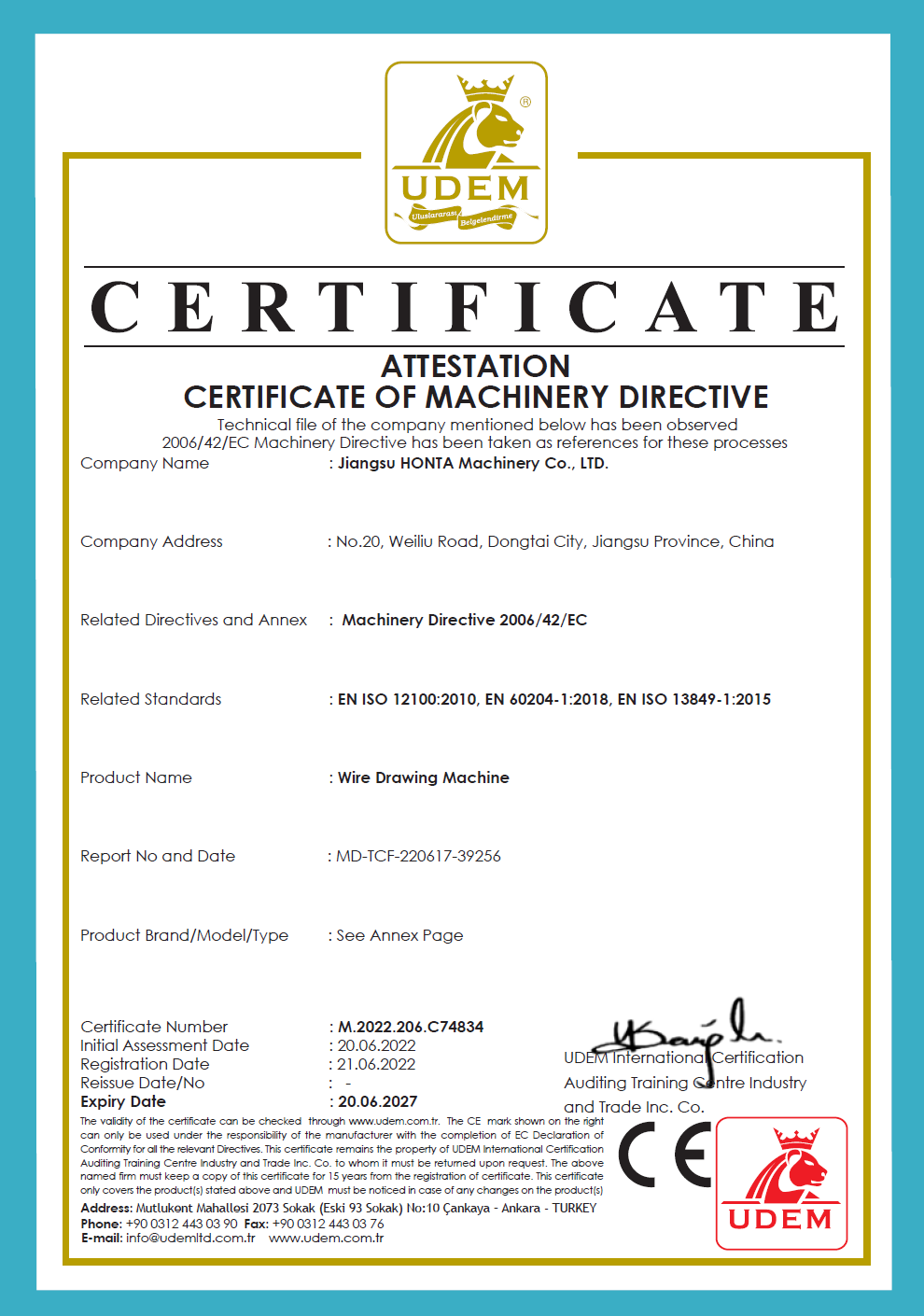
CE certification for HONTA wire drawing equipment, valid from 2020 to 2027.
For global projects, IEC 60204-1 is also a key electrical benchmark. It defines wiring practices and safety requirements for electrical equipment of machines. A supplier that openly documents compliance with this standard is usually easier to audit and integrate into an existing plant.
For quality and environmental management, HONTA maintains ISO 9001 and ISO 14001 certifications, which are commonly required for global project compliance.
2. Match the Wire Count and Diameter Range to Your Product Mix
The most important parameter cluster is the wire count and the inlet/outlet diameter window. The HONTA model HT.MD100B.16.22D.01 is a 16-wire multiwire drawing machine. Its inlet wire diameter is 1.8–2.0 mm and its outlet wire diameter is 0.18–0.5 mm. For an engineer, this means the machine is intended to draw medium-fine wire from an upstream rod breakdown line, not to accept heavy 8 mm rod directly. If your process produces fine wire for power cables, automotive cables, or communication cables, this range may be a strong fit.
3. Evaluate Individual Motor Versus Common-Shaft Configuration
Machine configuration has a direct impact on energy consumption. Traditional common-shaft systems use one motor to drive a line shaft, with mechanical elements transmitting power to each drawing capstan. Individual-motor systems give each capstan its own drive. According to industry technical analyses, individual motor multiwire drawing machines can reduce energy consumption by up to 25% compared with traditional common-shaft systems because mechanical transmission losses are eliminated. This is a budget constraint that becomes more important with continuous production.
4. Confirm Control System and Integration Capability
The HONTA HT.MD100B.16.22D.01 uses Siemens motors and a Siemens PLC. Under PLC control, the machine supports automated or semi-automated operation, computer-screen parameter settings, and automatic tension modes. This is relevant if you need stable tension across all 16 wires at high line speeds.
For a complete drawing section, the machine can be paired with supporting equipment such as annealing furnaces, pay-off/take-up units, winding/unwinding machines, inline annealers, and single/double-disc take-up machines. Buyers planning a full rod breakdown line with an annealer should confirm these interfaces early, not after the machine is already installed.

High-speed wire drawing machine close view.
Step-by-Step Verification Workflow
- Define the process requirement. Determine your input material (copper or aluminium), upstream rod diameter, and required outlet wire range.
- Choose the wire count. Multiwire machines are available in configurations such as 8, 16, 24, or 32 wires; the correct count depends on your downstream stranding and capacity plan.
- Confirm the machine model matches your wire range. For HONTA, the HT.MD100B.16.22D.01 covers 16 wires with inlet 1.8–2.0 mm and outlet 0.18–0.5 mm.
- Review certification documents. Ask for the CE certificate and check the certificate number, issuing body, validity period, and referenced standards.
- Verify components. Confirm motor and PLC brands; in this case, both are Siemens.
- Assess customization and MOQ. HONTA operates in ODM mode, supports customization of colour, model type, and components and parts, and offers a monthly capacity of 15 sets with an MOQ of 1 set.
- Plan the lead time and after-sales support. The standard lead time is 90 days; after-sales support is available remotely or on site.
Use Cases: Where a CE-Certified 16-Wire Machine Fits
HONTA equipment is used in power and energy, automotive manufacturing, communications and electronics, intelligent equipment, construction and installation, household and electronics, and new energy cable/conductor sectors.
For a wire and cable factory producing copper fine wire, a 16-wire multiwire drawing machine with an outlet range of 0.18–0.5 mm is a common choice because it balances productivity and flexibility. For aluminium conductor lines, the same machine can be integrated into a rod breakdown line with an annealing furnace to produce soft aluminium wire. If the factory also operates bunching machines, the 16-wire output can be designed to match the number of ends required by a high-speed double twist bunching machine.
HONTA case records show that wire and cable factories in the United States, Poland, Portugal, Spain, and Turkey have purchased two sets of HONTA wire drawing machines for wire drawing applications. After three years of operation, clients report that the machines steadily produce products that meet requirements, with fast speed and high efficiency.
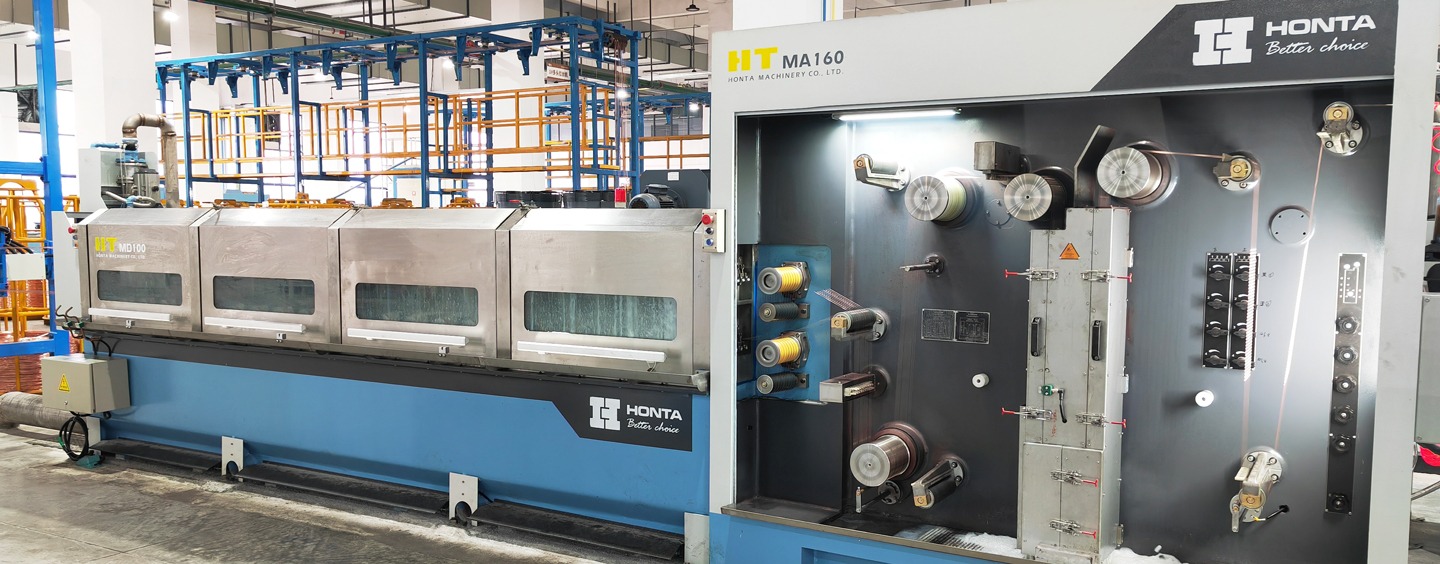
Wire drawing machine drawing tank detail.
Comparison Table: What to Check in a Multiwire Drawing Machine Quotation
| Verification point | HONTA HT.MD100B.16.22D.01 | Why it matters |
|---|---|---|
| Wire count | 16 wires | Determines output per pass and downstream line balance |
| Inlet wire diameter | 1.8–2.0 mm | Must match your upstream rod breakdown output |
| Outlet wire diameter | 0.18–0.5 mm | Defines the final wire range you can sell |
| Motor | Siemens | Affects spare part availability and maintenance |
| PLC | Siemens | Affects automation, data integration, and operator training |
| CE certification | M.2022.206.C74834 (2020–2027) | Confirms legal compliance for EU-bound machinery |
| Electrical safety reference | IEC 60204-1 | Global benchmark for machine electrical safety |
| Drive configuration | Individual motors | Can reduce energy consumption by up to 25% vs common-shaft |
| Customization | ODM; colour, model type, components and parts | Supports specific plant layouts and product requirements |
| MOQ | 1 set | Allows pilot installation before full-scale rollout |
| Lead time | 90 days | Must fit into your project schedule and installation window |
Frequently Asked Questions
Does the HONTA HT.MD100B.16.22D.01 multiwire drawing machine meet CE and IEC 60204-1 requirements?
Yes. The machine is covered by CE certificate M.2022.206.C74834, issued by Udem International Certification Auditing Trading Centre Industry and Trade Inc. Co., valid until 20 June 2027. The certificate references Machinery Directive 2006/42/EC, EN ISO 12100:2010, EN 60204-1:2018, and EN ISO 13849-1:2015. IEC 60204-1 is the electrical equipment standard referenced in the certification process.
What are the key technical parameters of HONTA's 16-wire multiwire drawing machine?
The HT.MD100B.16.22D.01 is a 16-wire multiwire drawing machine with an inlet wire diameter range of 1.8–2.0 mm and an outlet wire diameter range of 0.18–0.5 mm. It uses a Siemens motor and Siemens PLC, supports automatic tension modes, and can be integrated with pay-off/take-up units, annealing equipment, and single/double-disc take-up machines.
How does the individual-motor configuration affect energy costs and total cost of ownership?
Industry technical analyses indicate that individual motor multiwire drawing machines can reduce energy consumption by up to 25% compared to traditional common-shaft systems by eliminating mechanical transmission losses. For continuous production, this can have a meaningful impact on operating cost and total cost of ownership.
Can HONTA customize the machine or provide a pilot unit before bulk purchase?
HONTA operates in ODM mode and supports customization of colour, model type, and components and parts. Monthly capacity is 15 sets, with an MOQ of 1 set, so a single machine can serve as a pilot unit. All machines are 100% tested before shipment, and after-sales support is available by remote or on-site service.
What is the typical lead time for a HONTA multiwire drawing machine?
The standard lead time is 90 days. For project planning, this means you should start the ordering process at least one quarter before your planned installation date. To confirm current scheduling or request a quotation, contact HONTA directly at tammy@jshonta.com or via WhatsApp +86 187 5292 2675.
Conclusion: Use Certifications and Parameters as Your Gate
A multiwire drawing machine is a long-term investment. The fastest way to reduce procurement risk is to create a gate: first validate certification and electrical safety, then match wire count and diameter range, then compare drive configuration and energy consumption, and finally review lead time, MOQ, and after-sales support.
HONTA's HT.MD100B.16.22D.01 is a useful reference because its CE certificate, technical parameters, and production constraints are documented. The machine covers 16 wires, inlet 1.8–2.0 mm, outlet 0.18–0.5 mm, with Siemens motor and PLC, individual motors, ODM customization, MOQ 1 set, and 90-day lead time. Use the checklist in this article to evaluate any supplier quotation.
Next step
To request a machine quotation, inspect the full drawing machine catalogue, or ask for a CE/parameter verification for your product range, contact HONTA:
Email: tammy@jshonta.com | Tel: +86 182 6287 9467 | WhatsApp: +86 187 5292 2675
Have Questions or Need More Details?
Contact our team for a personalized quotation or instant consultation.
Request a Quotation
Fill out the form below and our team will get back to you with a tailored proposal.
WhatsApp Direct Chat
Prefer to chat in real-time? Message us on WhatsApp for instant assistance & quick answers.
- Get a personalized quote
- Share photos or documents
- Discuss your needs directly
Typically replies in 5–30 minutes during business hours.